Blog Archive

Wednesday, 15 March 2017

Mar 8th - Last Day on Easter Island

Mar 8th - Last Day on Easter Island

Our last full day in Rapa Nui and we wanted to make the best of it so we got up to watch sunrise over the 15 heads at Tongariki. It wasn’t too much of a challenge as the sunrise time was 8.13am !!
Just a little later than our usual……….. We set off at 7.30 after cramming Janette & Mandy into the back of the tiny jeep, which with Steve driving meant one of them had to sit across the back seat as there was no leg room !!  After 40 mins of Easter Island potholes in the dark there were some choice phrases coming from the back row !
Believing that we would be the first and possibly only people there, we were surprised to see over 100 people already there and feeling all spiritual.

We got to the site and Steve got set up with tripod & camera and we all then just stood & watched the sun slowly rise over these massive Maoi statues.


It was incredibly atmospheric & not something we will easily forget. Just a wonderful sight.


After another 40 minutes bumping, cursing & yelping back to Hanga Roa in our executive Jeep for a good breakfast and then we were ready for our next foray.
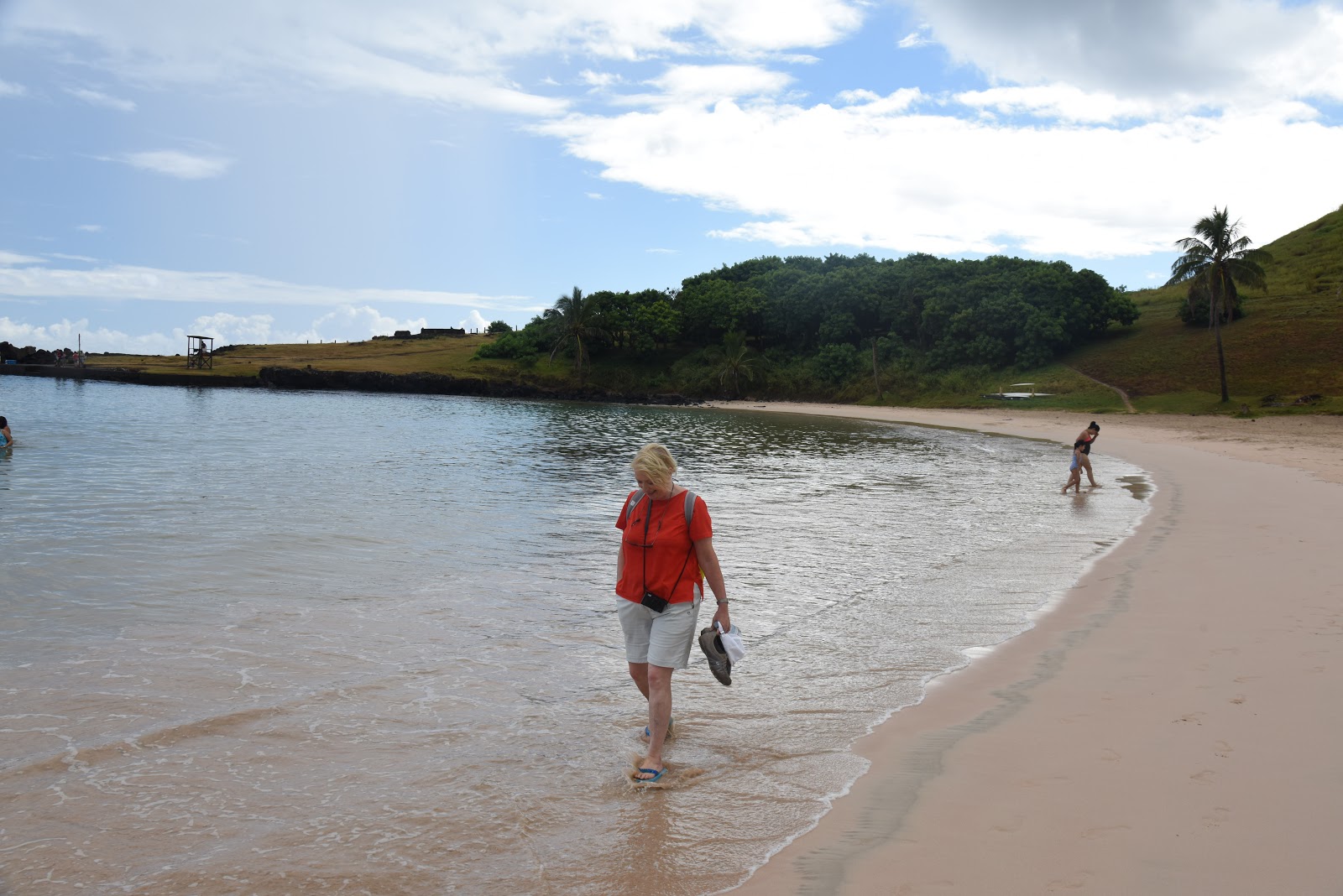
We headed back to the coast road and stopped at some of the other sites along the way to Anukanah where we stopped off at the beach for lunch and a swim.


Back then to Hanga Roa via 2 more sites for the compulsory afternoon ice cream where we watched the world go by and checked out some of the high end cars on the island…………

t was a very tight fit in the jeep...fortunately we are all good friend
...well we are now!!
The car then had to go back and we headed back into town for dinner & drinks at our favourite sunset spot.


What a special place Rapa Nui is. Full of history and legends, defined partially by its remoteness but with a friendly people with a huge sense of identity in a little island paradise. We have all loved it here and found it so not what we had expected. We will be sorry to move on…..but move on we must and now we are getting ready to fly back to Santiago and then on to Mendoza (the hard way) which turns out to be very different to the plan.

Next - Mendoza, home of Malbec wine

Mar 7th - Rapa Nui continued

March 7th - Rapa Nui - continued

Our first day in Rapa Nui had focussed on the major important sites. Our second day in Rapa Nui was looking at the exceptions and unusual Maoi as well as some of the local geology and its significance in Rapa Nui history.

We started with a visit to a Maoi in one of the small harbours the local fishing vessels use. It is also the location of the only Rapa Nui Chilean coastguard boat which is just a large zodiac, not nearly enough to prevent overfishing in these waters by large vessels.
There is a proposal to make an area of ocean a marine reserve to protect both from overfishing and to provide safe nurseries for the local fish and a source of line fishing for local Rapa Nui small boat fishermen.


From there on to a site Te Peu with 5 stone Maoi heads with a difference.
These are the only ones facing outwards and the significance here is that they are perfectly aligned with the winter & spring solstice and are facing the direction of Tahiti where it is believed by the Rapa Nui that their ancestors came from following a dream the king had. The Polynesians believe dreams are the way the dead communicate with them and took this dream as a message. They set off in large canoes are arrived at Anakaren which we visited yesterday.
They believe these Maoi are facing back towards their homeland channeling the Mana (power) of their ancestors.


Next stop was the quarry at Puna Pau where the red stone that was used for the topknots of the Maoi was from. This is the only location in the island to have this red volcanic stone. The Rapa Nui believed that anything to do with the head signified power and status (hence the stone head Maoi’s) and therefore a topknot of special coloured stone was seen as extra status.


This even extended to their early dealings with foreigners, when a sign of high status was a sailors hat !


Female Maoi - The only one on the island
All of the Maoi so far had been male as they were the leaders of the clan, so our next stop at Vinapu was one of the unusuals – a female Maoi. These were apparently very rare during the Maoi period.


At a point in history, the resources on the island became scarce. All the trees had been used, rats had destroyed the palms that produced coconuts and the islanders began warring over the scarce resources. At this point the Maoi carving ceased as they no longer had the time or resources to afford it.  As part of the war, many
Maoi pushed over in their war 
Maoi were toppled by enemies as a way of dishonouring an enemies ancestors.
After the war, the people were so poor and enslaved, they turned against the ancestors for not looking after them and giving them good Manu and they then toppled their own families Maoi’s.

The island was annexed by Chile in 1888 and they then rented it and all the inhabitants to a British company called Williamson & Balfour and they populated the island with sheep and virtually enslaved the local population through to 1953.  (Another embarrassed to be British moment in our travels..)
At this time the islanders were so unhappy, many of them left the island in canoes to look for new lives and there is a memorial to some of these at the little harbour we visited first today. Many were lost at sea. The nearest island is the Pitcairns 2000km away half way to Tahiti which is 4000 km away and mainland Chile and the Galapagos Islands both 3500km away.
It really brings home the vastness of the ocean when you travel for 5 hours by plane and see no land at all and these seas are high swell & rough.


Our last stop for today was Rano Kau and Orongo. Rano Kau is the largest volcanic crater on the island, which is completely volcanic with many small craters. It was just stunning, filled with fresh water and a complete eco system of its own from seeds dropped by birds etc. It had oranges, mangos, avocado and a locally used herb which when tested by biologists proved to have natural antibiotic properties and is now used in drugs to help prevent organ rejection after transplants.

Until the 1960’s the local people used to bring their washing up here and climb down the track into the crater to use the fresh water for their washing. They would then dry it on the rocks and spend the day there eating fruit and enjoying the area.
It has the most tranquil atmosphere, it is easy to see why it was seen as such an important site for the Rapa Nui people.
It was also significant in the Birdman ceremony, which evolved after the belief in ancestors faltered as a way of identifying the family or clan that should rule the island for the next year.


The strongest warrior from each clan would in the spring when the birds nested on Moto Nui island, join a competition where they had to climb down the outside of the crater to the sea, swim to Moto Nui island, stay there for several days until the sooty terns laid their eggs, then they strap the first egg to their head, swim back and climb back up the crater. First one back is the Birdman for that year.
A temporary village called Orongo at the  edge of the crater opposite the island came into use each year for the family chiefs and supporters to use during the competition.
Not a game for sissies, they had no climbing aids, tried to knock each other off the cliff, the seas are very rough with huge breakers onto the rocks and all of this with a fragile egg.
The head of the family that the victorious Birdman came from would manage the islands resources and rule for one year until the next competition.
Birdman carvings -
Annual event that lasted many years

By this time we were again melting in the hot afternoon sun, so we called it a day and headed into downtown Hanga Roa for home made ice cream.

Only 28c but the air is rare and the UV index maximum and with the high humidity made walking a long way tough.


As we walked through, the local fishermen were unloading a Blue Marlin just caught from a small canoe.


Once we had cooled off, we headed for the Catholic church which we had been told to visit to see the representation of Christ and the Virgin Mary. 


When we got there we could see why………they were all Rapa Nui !!


We had decided for our last day to hire a car and get up for sunrise at Tongariki and then drive round the island to see places we hadn’t covered. Car hire was mega expensive (captive market !) so we hired the lowest price we could so we ended up in a Suziki Jimmy 2 door jeep. This was to prove a painful economy !!


Time for dinner and from recommendations, we found a great restaurant on the sea with a good table and great fish. Steve and Paul channelled their inner cocktail drinker and downed some very strong raspberry mojitos !!  Sunset was beautiful & then they lit a fire and everyone sat round drinking in the glow. Very special…… 

Another day in a little paradise island !


11 Heads of Easter Island
 - 4 not working well due to heat

Saturday, 11 March 2017

Mar 06 - Introduction to Rapa Nui


March 06 - Introduction to Rapa Nui (Easter Island)

Our guide picked us up after breakfast and we headed off to explore the island & learn so much we didn’t know about this strange and fascinating island.

Our first lesson was that the name Easter Island was not the name used by the indigenous people. It was given by the foreigners who discovered the island on Easter Sunday. The local people use the name Rapa Nui which comes from the name of the island in Tahiti (Rapa) and Nui means bigger which was the name given by the Polynesian people who came and settled here in huge canoes.
They called it the Navel of the World. 

Easter Island has a population of 8000 and zero unemployment.  It is supported by Chile but they have a very definite cultural difference. There is a mayor appointed by the people and a head appointed by Chile.
With zero tax, its a fairly poor island relying on the supply airline LATAM airways which allows all locals an 82Kg baggage allowance a nd mos tof its income if from tourism and currently there are about 100,000 visitors a year. Tnere are still a lot of imports but fishing and farming are the mainstay although every inhabitant has an automatic right to land and so economic model is very different.....

So to pur first site of the day,  Tahal where we learned that the heads represent the ancestors of a clan. The heads all face inwards from the sea as they channel the positive spirit of the ancestors back to the living descendants. The Moai are all statues representing ancestors and if they are in groups they are all descendants of the same clan. The Moai were to signify stature and respect for elders and were expensive for a clan to do. They wanted to do this as the Rapa Nui believed their good fortune came from being looked after by their forebears and these statues were tributes to them.

Each Maoi is mounted on a platform called an Ahu and in front of this  there are stones which cover the umbilical cords of babies of that clan. Again the link to navels that is key to the beliefs and to the island being the navel of the world.
1896


This first Moai was a special one as it was the only one remaining with eyes. All the Moai had eyes, but they were made from coral and so didn't stand the test of time, so this was the only one on the island with eyes.
1894


From here we drove across the island which was also really interesting.
It is verdant,  green and has the most beautiful flowers, wild horses, a stunning coastline with high surf breakers and turquoise sea, very beautiful. It has a high rainfall so is very like a tropical island in vegetation which wasn't what we had expected at all when we came here. We expected a barren and austere environment, but it is very different to that. This probably came from the most common photos of the island from the 1950’s when it was barren. We would learn why over the next couple of days…


Janette cooling her feet in the very warm Pacific water
We went to the next site called Anakena which was where the first canoes landed and where the early kings of Rapa Nui lived. These Maoi are royal Maoi and have different carvings on their backs to represent the way they tied their loin cloths which signify their status within the society.


These are smaller Maoi and it is believed they were because they didn't need to impress with size for status as they were royal lineage.
The area here is very beautiful with a palm fringed beach leading into the warm Pacific sea & is used by the locals as a weekend beach area with picnics and food stalls selling fresh juices and snacks.
We all felt the need to at least have a paddle !!  


On then to Te Pito Kura. This is the site of the last Maoi to be put in place and also where there is a stone they call the navel of the world. They believe this stone was brought by the first king and has special Mana (positive energy) from the ancestors. Geological tests have shown it to be the only stone on the island to be high in magnetic iron.


We called them "The 15" each one about 10-12m tall
Note the one second from right - its the hair bun still very
much in use with Polynesian peoples today

From here we went on to Tongariki. At this site there were 15 Moai on a platform. These were all different generations from the same clan.
This site had been decimated by a huge tsunami in 1960 which had washed the Moai 150m inland. 
The site had been rebuilt but when they were cataloguing the Moai after the tsunami, they discovered remains from 33 Moai and discovered that they had built new Moai on top on the older ones, using them as part of the platform. With a stunning sea & cliff backdrop, this was a very atmospheric site.


Our afternoon visit was to Rano Raraku a quarry...............but one with a difference.
We had no idea the scale of the Maoi production, so this site just blew us away.


This was where the Maoi were from and surprisingly each Moai was carved in situ and then moved down the hillside down the road of the Moai to then be sent on its way to the its final site.

Production is in situ
here is one half way through

Moai production line
Production stopped at the outbreak of a war
This place was just unbelievable. Firstly, the sheer number of Moai that had been made & mounted round the island, then the massive number in the quarry under each stage of production, the painstaking task of carving these huge figures which took on average 40 men 9 months to complete and lastly, the sheer scale of the work that had been carried out and under way, we had no idea there were so many of these originally.


Then having completed the Maoi, they then had to move them up to 25km from the quarry to their ahu (platform) and install them.
imagine the disappointment if 40 people took 9 months 
to build it and it broke in transit like these !!
There was a route out of the quarry which was littered with broken Moai that had been damaged at this last stage as they were taken down the Maoi road. Imagine breaking one of these after a 9 month project….


Even with block and high factor sun cream
we were all struggling with the intense heat and humidity


By now we were completely melted as we had done all of this walking in the heat of the day with massive humidity and a very high UV level.

Even with factor 50 sunscreen we all had bits that had burnt so we went back to the hotel, jumped in the pool to cool off and try & absorb what we had seen.


We finished off with drinks in a little bar on the ocean with a good breeze, stunning Pacific view and watched the beautiful sunset over the breakers & surfers. 
What a place….astounding history, paradise scenery and fantastic island spirit ...we have been so lucky to be here and it is as removed from our expectation as it could be.


Mar 04 - Santiago Day Two


Steve needed to replace some camera gear and get some more camera chips in our last big city for a while so we don’t run out in Easter Island or the desert, so we headed out to the camera store we had found on google.

Paul & Mandy headed off to explore some of the areas we had seen yesterday from the bus and there was an artisan market on Saturday which was worth a look see. 

Lots of green spaces in Santiago - Cannobis shop!
Steve and Janette walked through the back streets of Santiago to the first camera store through leafy streets with really lovely houses. Although it is such a big city, there are lots of green spaces and trees on every street, we really like the city, it has a really good vibe.

There were some very interesting shops not found in other cities !


Unfortunately the camera shop didn’t have everything we needed so he directed us to another shop which was on the 5th floor of a residential complex – we would never have found it without his directions, but again we saw another whole section of Santiago. 

Very often, buxsiness and shops are in office blocks or houses so finding a supplier is not easy as it is at home.  You can only work on street names and number.


The view from the top of the world
 ...according to them anyway
By this time we had been walking for 4 hours in 28 degrees and almost 100% humidity so were pretty tired, so we jumped in a cab and scooted up to the Sky Costanera which is the tallest building in South America. It is 300 m high and the panoramic views from the 62nd floor of Santiago and the Andes was stunning. Not great for anyone with vertigo !!

The Andes surround this city which
 is only about an hour from the coast


Most people we spoke to did not have much good to say about Argenitinians and they dont seem to be good friends.
A lot of this is due to Argentina taking half of Patagonia in the early century but surprisingly, Chile is very pro British and supported the RAF during the Falklands debacle and Argentina have sulked ever since.


We got back to the hotel and were having coffee nursing sore feet when Paul & Mandy appeared looking just as shattered as us having walked out to the funicular and been to the zoo !


Rest now and then out for another evening in Santiago, walking through the street culture first , 
We headed to a great place recommended to us which had a hige selection of Chilean wines, available in tasting glasses or wine flights and great food, So we passed a happy evening trying some really lovely Chilean wines, including some great Carmenere. 

This area where we are staying is the trendy, artisan area but full of restaurants street artists, jugglers and musician....really nice vibe about the place and felt like a Mexican carnival town in places.


Day 2 of the famous 4 travels...in training

Janette and M\andy were very happy that you could have a wine tasting menu.  This meant that they could camouflage how much they really drank


Thursday, 9 March 2017

Mar 05 - Easter Island Bound !

Mar 05 - Easter Island Bound !

Early start today for our very exciting trip to Easter Island. In truth, we have noot researched this much so it is going to be a big surprise when we get there.
What we didn't know was that this island was going to hold a very big surprise for us.

Its a long trip, 5 hour (or 4800Km) flight as the island is half to New Zealand although still part of Chile. Next stop after here is Tahiti at 5900Km


The loonies are on tour again.
Pauls' hearing trumpet on display


Got to the airport to a very nice surprise that we were travelling Business Class !  We spent half an hour playing with our chairs and back massager and then Mandy the star went on a successful hunt for the champagne.


The flight needless to say passed very quickly !!
Flew over miles and miles of ocean, nothing but nothing apart from sea. 5000km of nothing to be precise !

First views of Easter Island from the air showed large breakers and a very green island. We landed the large dreamliner plane with little runway to spare. The runway is the full width of the island at that point !
Easter Island - a tiny dot in the ocean literally

We subsequently discovered that the reason the runway was so long and could take such a large plane was that it was one of the alternate recovery sites for the space shuttle and NASA had paid for the runway extension ! 


We got off the plane, entering the baggage hall to a wall of heat & humidity. The baggage hall was sweltering and we were all soon melting, especially Steve & Janette who had on their hiking boots & socks.
We were all carrying winter coats so looked very well prepared for the Easter Island 
weather.


We came out of the airport to be met by our guide for the next couple of days who put flower garlands on us & off we went. Steve and Paul looked lovely....


Don't we all look lovely !!


Our hotel in Hanga Roa (the only town) was about 5 steps from the airport runway but not a concern as there is only 1 flight a day in the afternoon !!  The hotel like all the building here is low rise and characteristically rustic but very nice with a little pool which the rooms sliding door open onto with a little terrace and shaded open air eating area. 
Most important - good air conditioning !!


The local taxi company was a bit of a concern
and its true to say that all of the taxis were
like this but many a lot worse.

We dropped our cases at the hotel and went exploring, The street map was very advanced....three streets turn left and that's the main street. There isn't much more !  By the time we had walked 3 streets, we were melting in the humidity so we stopped at the little shop that sold nothing but ice cream and ice lollies. We had only managed to walk half a mile before we needed to re-hydrate 


Steve found the local camera shop as he
was still looking for spares but to no avail


A trio of Pratts


We carried on down to the harbour and the fishing boats, all large canoe type boats, had just brought in a huge swordfish which the locals were carving up and apportioning out.
All very community oriented and interesting.


The only town and harbour 

All  of the restaurant fish is straight off  the boat

First day in this really unusual but extremely  humid place. Everything is pretty rustic but seems to kind of work, the people are fun & friendly, the atmosphere is very laid back. Certainly not advanced tourism but all the things you need are here in one form or another. The Supermercado wasn't super but did sell bottled water and every shop whatever its purpose sells carvings of the Maoi (the stone heads)


After a walk back and freshen up, we went back to the harbour area for a sunset drink and dinner.

We bagged a seat with a great sunset view and after a couple of pre dinner drinks watched the sun set over the surfers and some great cloud formations. For dinner, Mandy & Janette had some fantastic fresh huge tuna steaks, the local speciality. 


Really looking forward to our first day exploring the island tomorrow with our guide.

It was becoming clearly obvious  that Easter Island was not   some remote rock with a few stone heads on but a "paradise" like island with a spirit and massive history as well as a fair tourist business....Moreover, the people were relaxed and fun.